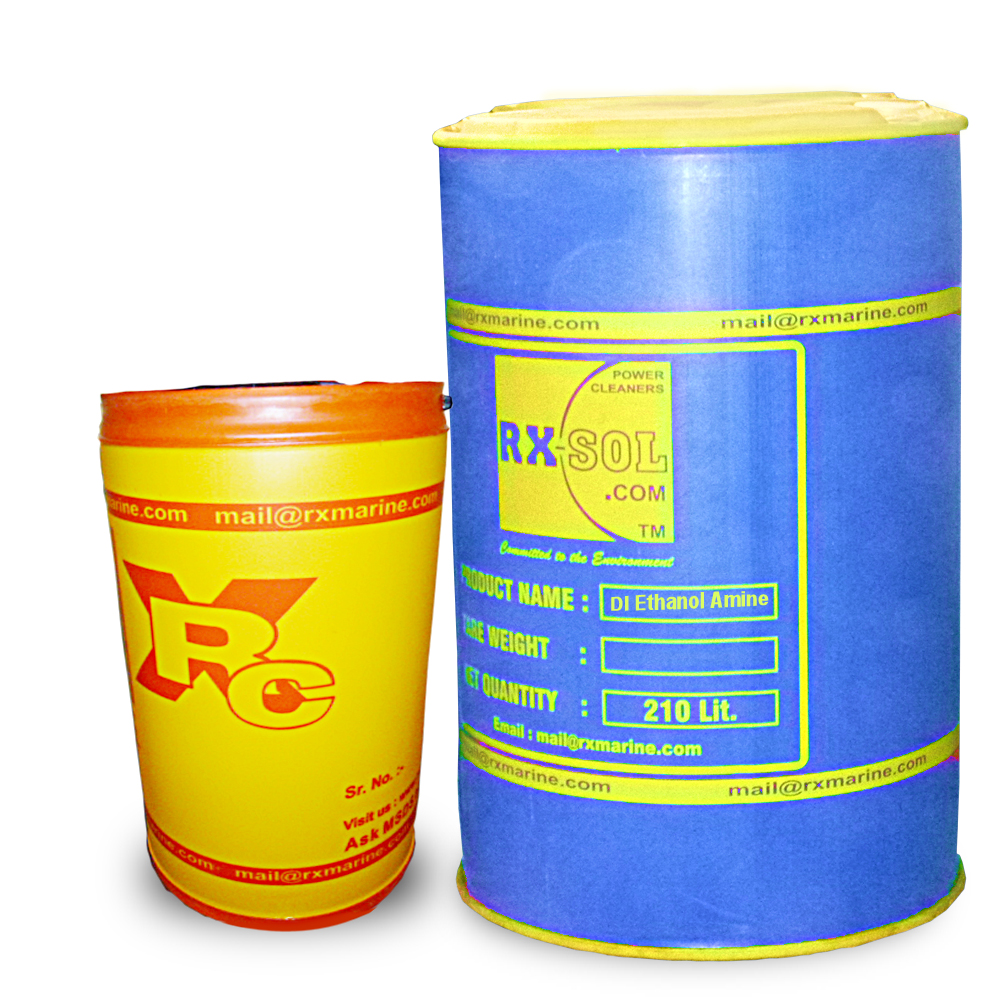
Diethanolamine DEA
Part No. RXSOL-67-1119-210
Diethanolamine
DiEthanolAmine-modified Sodium Lignosulfonate (DEA-SL) admixture for cement slurries, enhancing early strength and fluidity.
Key Technical Details
| Part number | RXSOL-67-1119-210 |
|---|---|
| Generic name | Diethanolamine |
| Standard packing | 210.00 |
| Supply locations | DI Ethanol Amine manufacturer supplier distributor in Mumbai, Kandla, Kolkata, Vizag, Chennai, India, Fujairah, Dubai UAE, Muscat Oman, Kenya Africa. Get the best quality of DI Ethanol Amine at a competitive price from us. We have ready stock of DI Ethanol Amine in India, UAE Gulf, Oman, Kenya Africa. Contact us for bulk as well as small orders. |
Diethanolamine-Modified Sodium Lignosulfonate Admixture for Early Strength and Water Reduction in Cement Slurry
DEA - DI ETHANOL AMINE is most commonly used as a surfactant in cleaning industries and as a corrosion inhibitor in oil field industries. DI ETHANOL AMINE chemically reacts and remove hydrogen sulfide and carbon dioxide from natural gas due this property DEA used in oil refineries as a deodourizer to remove hydrogen sulfide from sour gas.
Diethanolamine is a white, crystalline (sand-like) solid or a colorless to yellow, syrupy liquid with a mild Ammonia-like odor. It is used in specialty textiles, weed killers, detergents, shampoos, paints and metal-working fluids.
| PRODUCT NAME | : | DI ETHANOL AMINE |
| CAS number | : | 111-42-2 |
| UN number | : | 2735 |
| Formula | : | (HOCH2CH2)2NH |
| Odour | : | AMMONIA LIKE |
| Solubility in water | : | COMPLETE |
| Density | : | 1.09 at 20 oC |
| Boiling point | : | 269 oC |
| Melting point | : | 28 oC |
| Viscosity | : | |
| Flashpoint | : | 152 oC |
| Explosive limits | : | 0.1 mbar at 20 oC |
| Vapour pressure | : | 0.1 mbar at 20 oC |
| Skin absorption/irritation | : | YES |
| TLV Country NL Year 1995 | : | 3 ppm 15 mg/m3 |
| Pollution category 1994 | : | D |
DEA produced a dose-dependent decrease (58%) in the antibody-forming cell response to sheep erythrocytes at an 800 mg kg−1 exposure level.
If RXH is not acid enough to release a proton at alkaline pH, as it is the case with amines, then the reaction has to be carried out in two steps. During the first step the first EO mole is added at acid pH, so that the amine is transformed in ammonium. The reaction produce the mono-, di- and tri-ethanol amines.
Proton release from ammonium NH4+ →NH3 + H+ (here RX- is NH3) Then, the three condensation reactions:
NH3 + EO →NH2CH2CH2OH (mono-ethanol amine MEA)
NH2CH2CH2OH + EO →NH(CH2CH2OH)2 (di-ethanol amine DEA)
NH-(CH2CH2OH)2 + EO →N(CH2CH2OH)3 (tri-ethanol amine TEA)
With an alkyl amine, first the alkyl ammoniumion is formed and it is deprotonated:
RNH3+ →RNH2 + H+ (here RX- is RNH2)
RNH2 + EO →RNH-CH2CH2OH (mono-ethanol alkyl amine)
RNH-CH2CH2OH + EO →RN(CH2CH2OH)2 (di-ethanol alkyl amine)
Once the ethanol amine is attained, the EO polycondensation is carried out at alkaline pH as previously. In many instance the first ethoxylation is stopped when the monoethanol alkyl amine is formed in order to avoid the polycondensation in more than one chain.
Need Diethanolamine DEA for your operation?
Our team helps with product selection, dosage, safety data and delivery worldwide.
Request a Quote